

I guess the answer to this proposed question, as more often than not, is that it is all subjective? The WordPress prompt has asked me what makes me nervous? Well to be truthful I don’t think I am a particularly nervous person, but in the spirit of blogging and trying to answer the above question keeping my blog on topic of 3D design, and all that it entails, my answer is that modelling the ‘organic’ object in Blender makes me a tad more nervous, careful, and cautious than when I am modelling an ‘inorganic’ object…typically.


Here is an organic object I have modelled using Blender 4.0, this is all modelled manually by eye and hand, a slow process of just manipulating vertices and sculpting the object until you are happy you have obtained what you are looking for. This is a house-plant that was a rough interpretation of a Strelitzia plant:

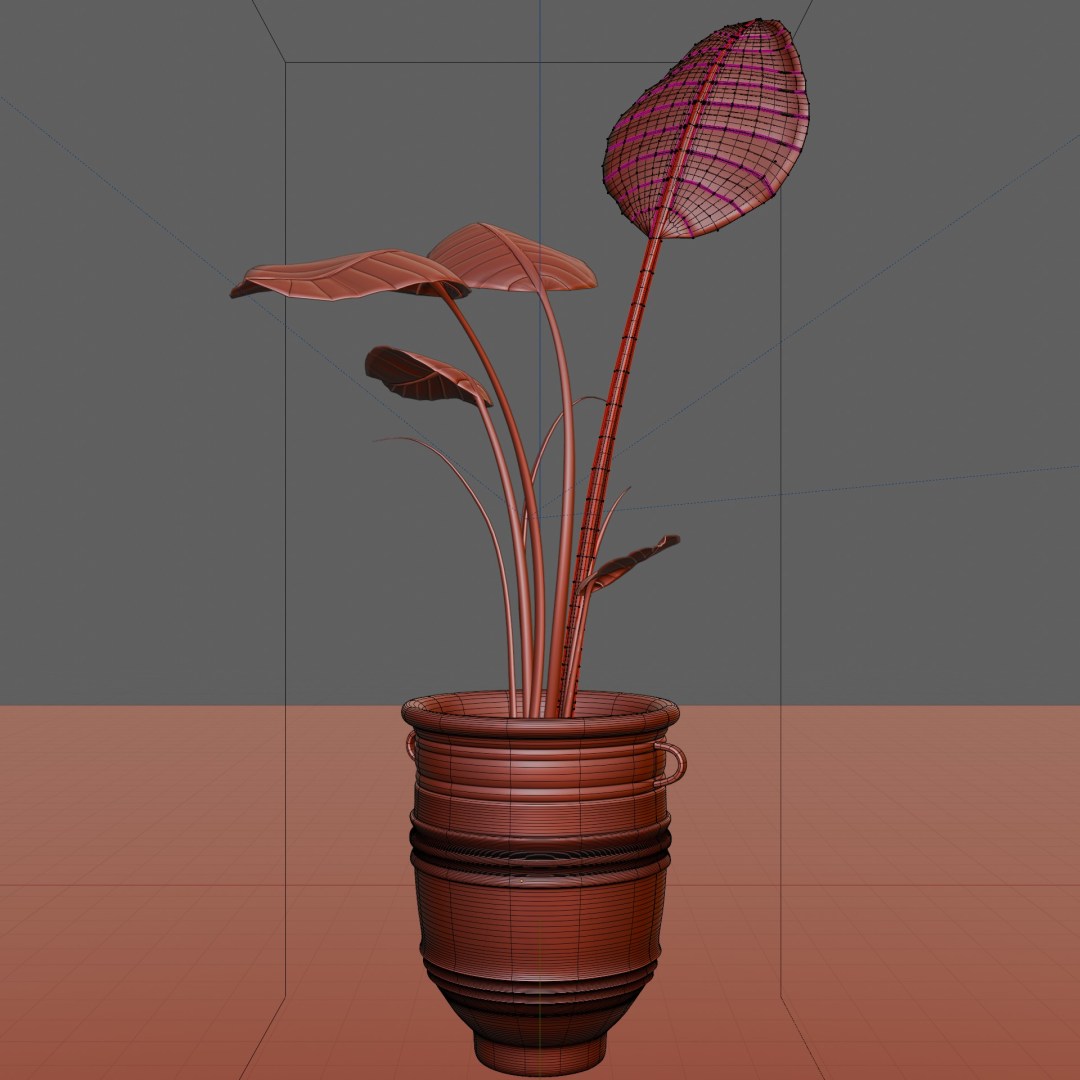

I modelled all of this plant and the Grecian style Urn manually, and applied procedural materials accordingly. The Urn was easier to model than the plant. Why? Again, I think it is because it is inorganic, and as such, it has more predictable topology and more straight lines than an organic house-plant.
This leads me on to this word of ‘topology’, a word probably quite well known to mathematicians and people in the design field, but to lots of people outside of these fields of work, the word is probably quite unknown…so what is topology in the area of 3D modelling and design? In the context of 3D modeling, topology refers to the arrangement of vertices, edges, and faces that make up a 3D model. Good topology is essential for creating models that deform and animate well, as it ensures the smooth flow of surfaces and efficient distribution of detail and light. It also impacts the model’s ability to be subdivided for additional detail without creating artifacts. Essentially, topology influences how well a 3D model can be manipulated, animated, and rendered.
In mathematics, topology is the branch of mathematics that deals with the properties of space that are preserved under continuous transformations, such as stretching and bending, but not tearing or gluing. It focuses on the concepts of continuity, convergence, and connectedness. Topology also studies the properties of geometric figures that remain unchanged when they are stretched, twisted, or deformed.
So with all that said, why do I get nervous modeling the organic🤔? Well, this is probably an exaggeration. I wouldn’t exactly say I get nervous, but with an organic object’s topology being more unpredictable and random, I find it harder and slower than modeling an inorganic object with its predictable topology, defined measurements, constraints, and more overall angular structure.
So that is it for this post 😊. I hope you like my model of a Strelitzia Plant? My only self-criticism is I am not entirely happy with the applied material, maybe it is too waxy looking so I may revisit it, but with it being generally a background model asset, it is not that high on the to-do list. But overall, I think it looks good…let me know your thoughts in the comments! and I hope you enjoyed learning what topology means, if you didn’t already know.
Have a great day everyone!
Kind regards, Jay

Discover more from Jayargonaut - Watch Designer
Subscribe to get the latest posts sent to your email.
 Jayargonaut - Watch Designer
I used CAD for years but I cannot image how you create the things you do in Blender. I won’t think about it much. I’ll just admire.
LikeLiked by 3 people
Thank you Leturos👍, I appreciate it. CAD software is great and has certainly come on. I am now also using some new CAD software called Plasticity 3d for hard surface models and design, it is great CAD software and almost bridges a gap with 3D modelling software like Blender. Blender is a fantastic all-in-one package of course, very powerful but a fair learning curve. If you ever fancy getting back into using CAD you should give ‘Plasticity 3D’ a try, you can grab a 30 day free trial, and it is very cheap if you decide to buy it – $150 for lifetime licence, which is a steal in the realm of CAD. It is quite easy to learn, very rewarding, and addictive to use👍. Best…Jay
LikeLiked by 2 people
Well, I can’t imagine you’re too nervous about it because it came out great, like everything you do! 😊 Looks good as always, Jay!
LikeLiked by 2 people
Ah, you caught me out Laura, yes nervous is an exaggeration to be honest, maybe slightly hesitant might be more correct😊. Thank you for your kind words Laura, I sincerely appreciate them! The engineered model is more my thing, so modelling the still-life organic is my self challenge. Your words are encouraging, thank you😊. I hope you are having a wonderful day/evening so far!
LikeLiked by 2 people
You’re most welcome, of course! And today has been pretty good, considering I’m off work, which is always nice! Thank you! 😊 hope you are as well too, and can’t wait to see your next project!
LikeLiked by 3 people
oh this is something new I learned today. thanks for the post.
LikeLiked by 3 people
Thank you Himanshi!…and you are welcome😊. I am glad you liked the post, and you learned something new. Kind regards…Jay😊
LikeLiked by 3 people
You’re welcome, Jay!
LikeLiked by 3 people
Very nice
LikeLiked by 3 people
Thank you for your kind words codingpro🙏. I sincerely appreciate them. Jay 😊
LikeLiked by 2 people
Most wlc my friend.
Plz follow us for new education and family article
LikeLiked by 3 people
So cool! When I was an architectural graduate 30 years ago, I remember my boss asking me to try out this new thing called CAD, “it won’t last,” he said, “but I don’t want people to think we’re not open to change, so give it a whirl for a few days and tell me what you think.” “Best thing ever”, I replied, “everyone should have it.” He agreed to 3 computers for an office of 50 drafters… ah… so very last century! Linda 🙂
LikeLiked by 2 people
Thank you for your wonderful comment Linda, what a great little story and comment, brilliant😄! I can just imagine all those 50 drafters poking and prodding at the new-fangled tech😄. It is amazing how things change and move on isn’t it. It is funny as you have jogged a memory for me. When I started working, I worked for a old established crankshaft engineers, most of my time in the metallurgy and inspection side. All of the crankshaft drawings that would circle the factory were drawn by 2 chaps constantly stooped over large drawing tables. Fantastic to think really. Kind regards…Jay😊
LikeLiked by 2 people