

My 17-year-old son is obsessed with black holes, and has been since he was very young, so much so that he is heavily studying advanced math and physics at college and wants to continue on to eventually do a PhD on black holes…he loves them! So, the other day he said, “Dad, you should model a black hole in Blender.” For those who do not know what Blender is – it is a 3D creative suite used to model 3D mesh objects, renders, animation, visual FX. It is a wonderful tool used by artists, hobbyists, all the way to the movie industry, and it is my tool of choice.
So for the last two days that is what I have been doing – modelling a black hole, and it was quite a task! Now this is by no means going to be a tutorial, and I am not taking the credit for originating the workflow for creating a real black hole in Blender. It is very complex, and was calculated and worked out by a very clever artist before me. I followed a long tutorial meticulously for two days to create the geometry nodes and complex materials to create a virtual realistic black hole. If you want to know how to do this please contact me and I will point you in the right direction!
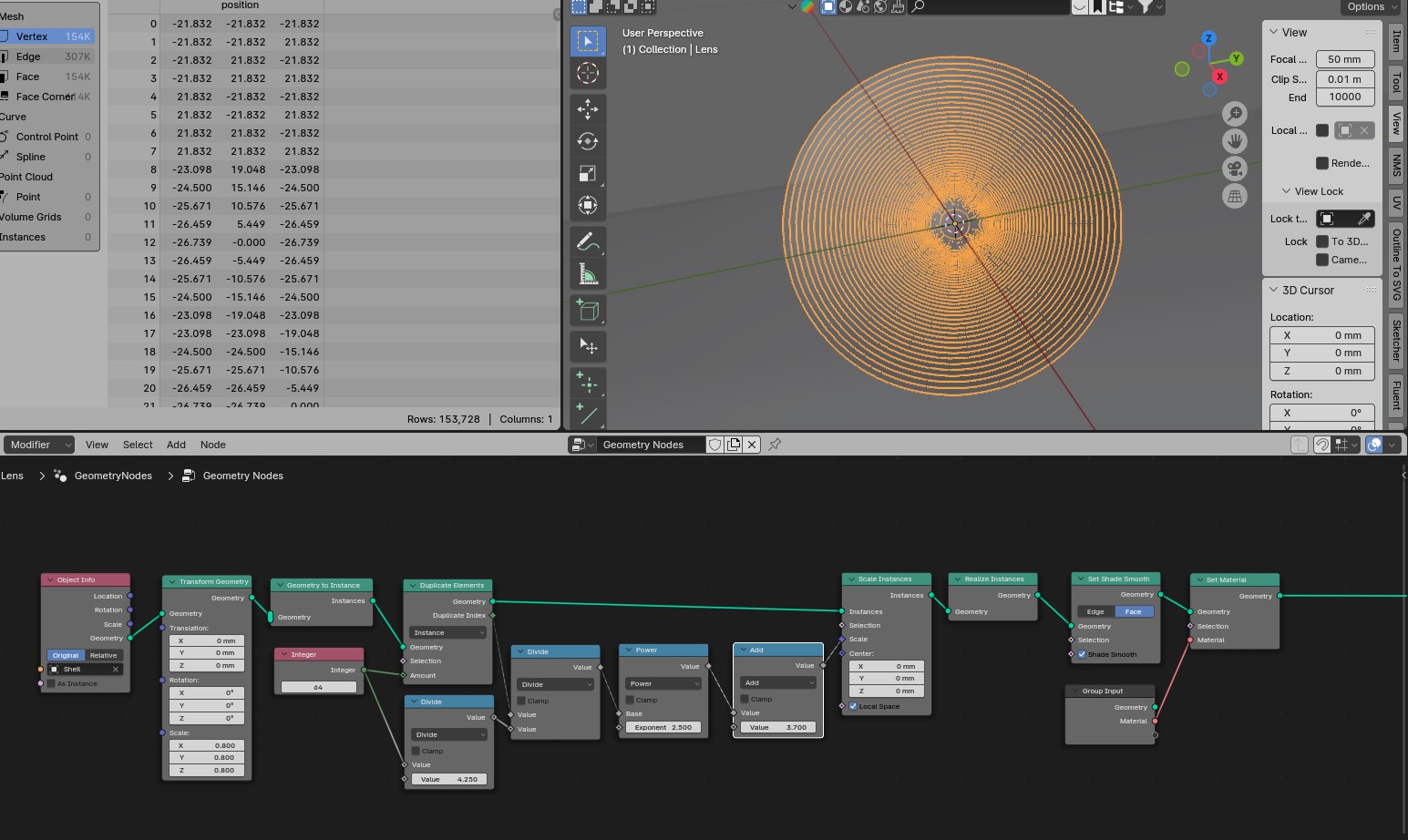
So in a very quick nutshell, this involved building a series of ever increasing concentric UV spheres using geometry nodes to create a ‘lens’ that essentially bends all light in a way that it replicates the functioning properties of a black hole:
Building the Lenses:
Building the Emissive material:
After you have constructed these spheres, or lenses, a solidified plane is placed around these lenses(we will call this an ‘Accretion Disc’), to which you apply a very complex emissive light material, that together creates the black hole effect…the lens ‘bending the light’ to give the black hole.
Building this material is what takes the time and contains a lot of math nodes, a very time consuming, but very satisfying procedure:

Rendering the Final Result of all this work:
After all of this work you can render this out, with some post editing, you will have yourself a beautiful black hole 😊:


But without further ado, I want to introduce my scientist Son ‘Freeman’, who is the black Hole expert and is going to educate us all on real black holes👏.
Over to ‘Freeman’ – The Science of Black Holes:
One key point about the render you see is that it is based on something that is purely theoretical: the Schwarschild metric. Named after the person who derived it, the metric is an exact solution to Einstein’s field equations. In layman’s terms, these equations state that space and time bend as a result of mass. The bending of space is a concept that is easier to conceptualise than the bending of time, as shown in the following figure:
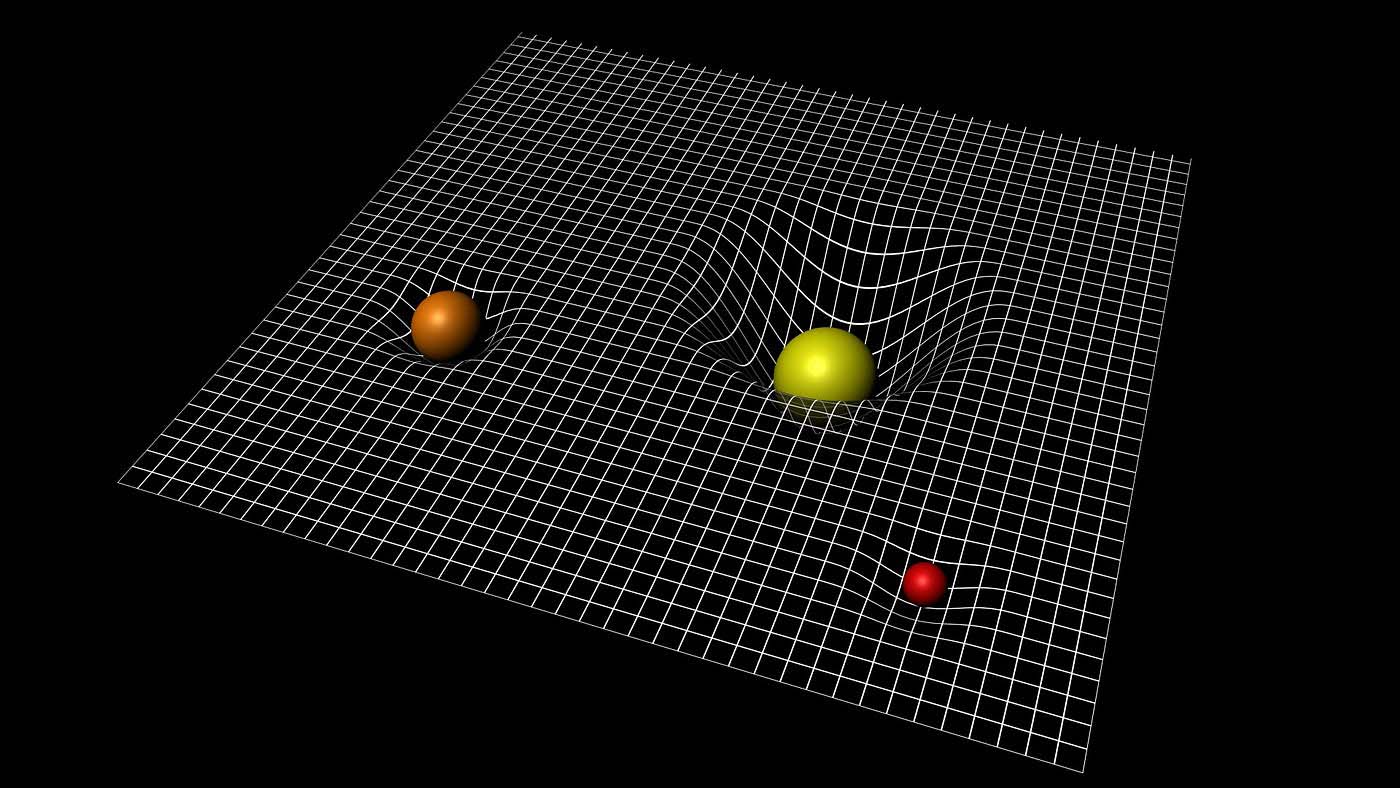
In summary, these equations state that the more mass there is at a point in space and time (or spacetime for short), the more space is bent and the slower time ticks.
The Schwarschild solution:
The Schwarschild solution can be used to describe what is known as a Schwarschild black hole (this is what you see in the render). This model takes the black hole as having no charge (like a neutron) and no spin. No spin is a key point. This means the black hole is perfectly spherical. The fact that all observed things in the Universe move and spin, and through logical deduction, the likelihood that a black hole has no spin is zero to none.
So, if the Schwarschild solution is not applicable in the real ‘world’, what is the point? Well, the solution is the gateway to understanding black holes and can be used as an approximation for several things. Take the following equation for the radius of a Schwarschild black hole:
rs=2GM/c2
where M is the mass of the black hole, G is the gravitational constant:
(6.67×10⁻¹¹m3kg-1s-2), and c is the speed of light (3.00×10⁸ms-1).
As you can see, the only variable is the mass of the black hole (c and G are constants and never vary). Black holes are formed from a region of matter becoming so dense that not even light can escape as a result of the surrounding gravitational pull. So, if we plug in the mass of the earth (5.97×1024kg), the equation will spit out the radius at which all the matter on Earth (including you) will need to shrink in order to become a black hole. The answer gives a radius of just 8.8mm-about the size of a grape! Here is a life-size replica:
We can reverse this logic and calculate the mass required to form a black hole of radius 6.37×10⁶m (the radius of the Earth), this comes to a mass of 4.3×1033kg-equivalent to the mass of over 2100 Suns!
One idea worth exploring is why a Schwarschild black hole looks the way it does. As highlighted earlier, any mass in spacetime also bends it. This is why space looks distorted near and around the black hole. Black holes bend space so much that not even light can escape from it; hence, the absence of light at the centre of the rendered image.
The ring of light you see at the border of the ‘shadow’ of the black hole is known as the photon sphere. At this point, light actually orbits the black hole. As a result, suppose you were in the photon sphere… The light from the back of your head will orbit the black hole only to arrive at your eyes. You will see the back of your own head. Aren’t black holes fascinating?! – ‘Freeman Edwards‘
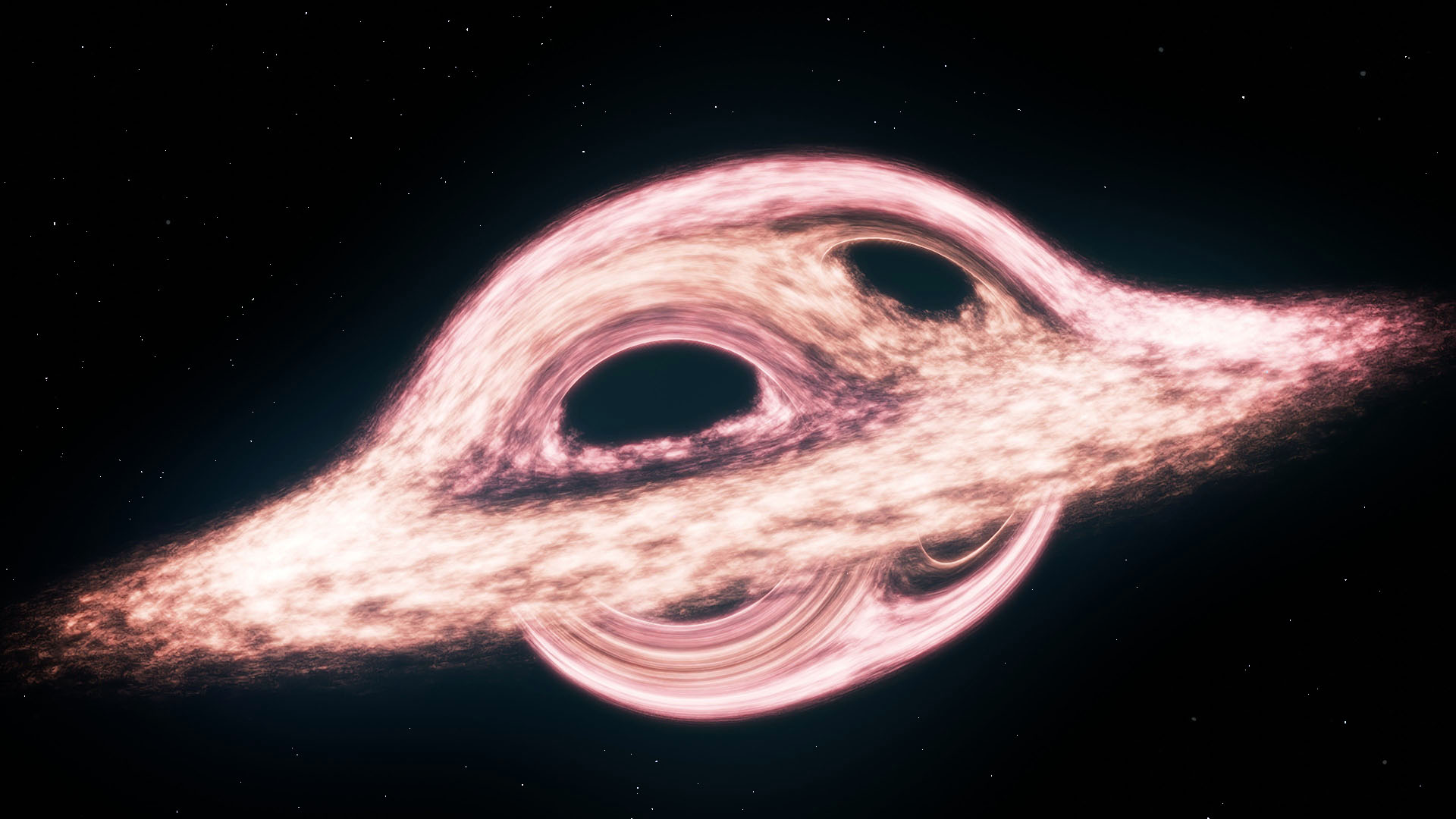
We also Modelled two Black Holes Colliding – Woah!…
Well that is it for this post, I hope you like our models and Freeman’s introduction to the science of black holes. Please feel free to comment, and if you want any more information on how to model this, or the science behind black holes, please get in touch!
Have a great day and evening😊!
Kind regards, Jay & Freeman

Discover more from Jayargonaut - Watch Designer
Subscribe to get the latest posts sent to your email.
 Jayargonaut - Watch Designer
Great post. My oldest son was interested in physics. He published a couple of peer reviewed articles when he was twenty and started his PhD program soon afterward. He left astrophysics a few years later for another field (he’s now a digital warrior) but I’m sure he’d love (and understand) this better than me (I left physics for engineering when I was still 17).
LikeLiked by 1 person
Hey Leturos. Good on him, you must have been proud of him when he did that! Shame he left the field, but as long as he is doing what he loves do that is all that matters. I find it interesting, but must admit the math my Son talks is above my level. Best, Jay
LikeLiked by 1 person
If you download an image of Powehi, the black hole at the center of the M87 galaxy, and use the explode effect enough, then finally use a little bit of night mode filters, you can see the inside of that one black hole. Of course, increasing a bit of brightness could really help. The night vision is only for making the inside easier to see the textual features.
It’s quite interesting.
Great post, by the way! 😁 I wonder if Freeman has autism like I do? 🤔
LikeLiked by 1 person
Hi Joseph. Thank you for this, we have just found an image of it, then we are going to look as you suggest👍. Your comment made Freeman chuckle by the way, I would say yes he has, in a friendly way😄, he is obsessed with this stuff and numbers, a space geek! but studies hard too.
Thank you for your positive comments Joseph, we both really appreciate it😊…keep looking to the stars my friend👍.
LikeLiked by 1 person
You’re very welcome. 😊 And I sure will! 😁
LikeLiked by 1 person
Oh, just to make sure you know, it’s the explode effect. The implode effect unfortunately just makes a garbled mess. You’ll know you did it right if you see a bunch of circles acting like gravity waves, which night vision should make them varying shades of green. 😉
Good luck! 😊
LikeLiked by 1 person
Thank you for the advice Joseph, appreciate it🙂👍. You have an interesting blog by the way, I got sidetracked on it. Have subscribed as you have some interesting reading on there, cool stuff.
Cheers, Jay & Freeman 😊
LikeLiked by 1 person
Wow, very cool blog. I’m also a space nerd. As a kid, used old-fashioned star maps and flashlights with red cellophane to preserve night vision. Now all you do is orient and punch in the object and bzzzz the telescope takes you right to the desired RA/Dec spot. What’s the fun in that?
Fascinating that the earth would need to shrink to the size of a grape to become a black hole. Love this kind of stuff! 😎👍
LikeLiked by 1 person
Hey Darryl. Thanks 😊. That is cool, yes things have almost become too easy I think haven’t they, it kind of sucks the adventure out of things a little. Don’t get me wrong, I guess this technology helps in answering many things, but definitely know what you mean.
Isn’t it🤔! Some of these facts I don’t think our human brain can conceptualise very well. You should talk with my Son, his ambition is to answer the riddle of blacks holes, and he will talk for hours & full of these facts😃. Thanks for the great input my friend & stay fascinated👍.
LikeLiked by 1 person
Just one more PS. I was at Florida when Voyager 1 flew by Jupiter and we had our first-ever close up pix of the cloud belts, Great Red Spot, etc. vs grainy earth-based ones. The event was hosted by the great “billions and billions” Carl Sagan. It was unreal, I’ll hafta blog about it someday 😎
LikeLiked by 1 person
Wow, now that is cool😎!! What a memory for you! Ah yes, the great Carl Sagan, I loved watching him when I was a young lad, there was a show that ran here in the UK that I watched with my Dad….Carl Sagan journeying through space, great stuff!
LikeLiked by 1 person
Thanks 👍
LikeLike
Woooohoooooo!! This is SO COOL! Thank you to both Freeman & you for sharing it!
Blender perches on my desktop, a symbol of hope. When I’m able to sit there for extended periods of time I’ll open the program and see what we can do together. I’m in awe of your model! And Freeman’s commentary was eye-opening! 👏👏👏👏👏
I esp like the collision at the end of the post bec years ago I made a digital compilation of fractals and photography that I named, “When Wormholes Collide.” It was surely inaccurate (scientifically) but fun to explore.
(Thank you for visiting & for the Like — I rarely answer these prompts but couldn’t resist today’s.🙃)
🤗
LikeLiked by 1 person
Thank you my friend for this inspiring and kind comment🤜🤛😊. Great comments like this make the whole thing worthwhile!…sitting there for hours & hours grinding away…as you know yourself by your comments, and by the looks of your blog too. I just showed Freeman your comment, as he is sat next to me grinding away at his Chemistry studies, made him smile😁…he is the guy when it comes to black-holes! you could say he is obsessed!!
The collision was Freeman’s idea, he kept bugging me….”Dad, lets see what happens when two black-holes merge and collide”, so I had to oblige in the end. Like your wormhole event, I am not entirely sure if it is actually what would happen🤔, but it looks so cool doesn’t it!!
When Freeman answer’s all these black-hole and wormhole riddles, and writes his book with all the answers…we will either be proven right, or have to revisit our compilations and models!
You are welcome on the likes my friend, gonna take a deeper look at your blog…and thanks so much for the great response🙏🙏🙏. Best…Jay & Freeman
LikeLiked by 1 person
Hooray for smiles, experiments, imagination, & new friends!! Thank you!! 🥰
(I’ll see if I can find that wormhole thing I made, will post for you if I do.)
LikeLiked by 1 person
It’s a hard thing to create, I’ve tired it and failed miserably. lol
LikeLiked by 1 person
Hi Simon. Yes, it is a lengthy process creating it, and with so many nodes you can start to get lost in them all😕…fairly easily! It is certainly a challenger! Thank you for the comment my friend & fair play for even attempting it👍. Kind regards…Jay
LikeLiked by 1 person
I’ll try again sometime soon I’m thinking
LikeLiked by 1 person
Go for it mate👍. It is a bit tasking, but rewarding when done!
LikeLiked by 1 person
Let’s see how it goes lol
LikeLiked by 1 person
Very interesting!
LikeLike
Thank you Tom😊. I am glad you liked the post and found it interesting! Kind regards…Jay😊
LikeLiked by 1 person
My pleasure!
LikeLiked by 1 person